What's the most IMPORTANT measurement in bowling?
The Positive Axis Point
Bowling.com Pro Staff Posted: July 30, 2026
Last Updated: September 13, 2026

Quick Article Summary: In-depth guide to the Positive Axis Point (PAP), covering what it is, why it’s the most critical measurement for accurate ball layouts, a simple step-by-step method to find yours, how it works with Dual Angle and other systems, and practical tips for keeping it current as your release changes.
Need more bowling tips? Search all of our bowling tip articles above.
Bowling is full of numbers and measurements that can overwhelm anyone stepping into the sport. Layouts, axis rotation, axis tilt, ball speed, rev rate, and the list goes on. But before you drill your next bowling ball, there’s one measurement that matters more than any other: your Positive Axis Point, commonly known as your PAP.
What is a Positive Axis Point?
When you throw a bowling ball, there is a single point on the surface that initially does not rotate. This point acts like the ball’s axle (the center of its initial rotation), and that unique location is your Positive Axis Point.
Every bowler has a PAP, regardless of style, rev rate, or whether you use your thumb. For right-handed bowlers, the PAP typically sits to the right of the grip; for left-handed bowlers, it’s on the left.
While your PAP can reveal certain characteristics about your release, its primary purpose is simple: it allows your pro shop operator to place an accurate layout on your bowling ball.
How To Find Your Positive Axis Point
Any bowler can find their PAP with minimal equipment. Here’s a step‑by‑step guide:
You’ll Need:
- A bowling lane (you’ll throw 1–10 shots)
- A piece of colored tape (different color than the ball)
- A phone or camera
- A measuring tool (soft tape measure, clothing ruler, or a Pro-Sect)
Step 1: Throw a Shot
Throw a shot and do not wipe the oil off the ball. When the ball returns, you’ll see oil rings. Locate the point in the middle of the first oil ring closest to your fingers and/or thumb.
- Right‑handed bowlers: this point will be on the right side of the grip
- Left‑handed bowlers: on the left side
Step 2: Mark the Spot
Place a piece of tape on that point. Don’t worry about perfect accuracy yet. You’ll adjust it several times.
Step 3: Record Your Release
Set up your phone to record your release and the first 20 feet of ball motion. You do not need to record the pins.
Step 4: Throw Another Shot
Watch the recording. Your goal is to place the tape on the exact spot that does not rotate as the ball leaves your hand. If the tape spins, adjust its location and repeat.
Step 5: Repeat Until the Tape Is Stable
Once the tape stays still at release, you’ve found the positive axis point.
Step 6: Draw Your Horizontal Line
Using your measuring tool, draw a horizontal line from the center of your grip.
- Thumb bowlers: center of grip = midpoint between fingers and thumb
- No‑thumb bowlers: center of grip = midpoint between the fingers
Step 7: Measure Horizontal Distance
Measure from the center of grip straight across to the tape. This is your horizontal PAP measurement.
Step 8: Measure Vertical Distance
Measure straight up or down from the horizontal line to the tape. This is your vertical PAP measurement.
Example PAP Measurements
- 4.5" over, 1" up
- 6" over, 2" down
- 3" over, 0" up/down
These two numbers (horizontal and vertical) define your PAP.
Why Does it Matter?
Your PAP is essential for accurate ball layouts. Without it, every layout is a guess. Some guesses may work, but you lose the ability to fine‑tune ball motion and build a consistent arsenal.
Pro shops rely on PAP to correctly apply:
- Dual Angle Layout System
- Vector Layout System (VLS)
- 2-Handed Layout System (2LS)
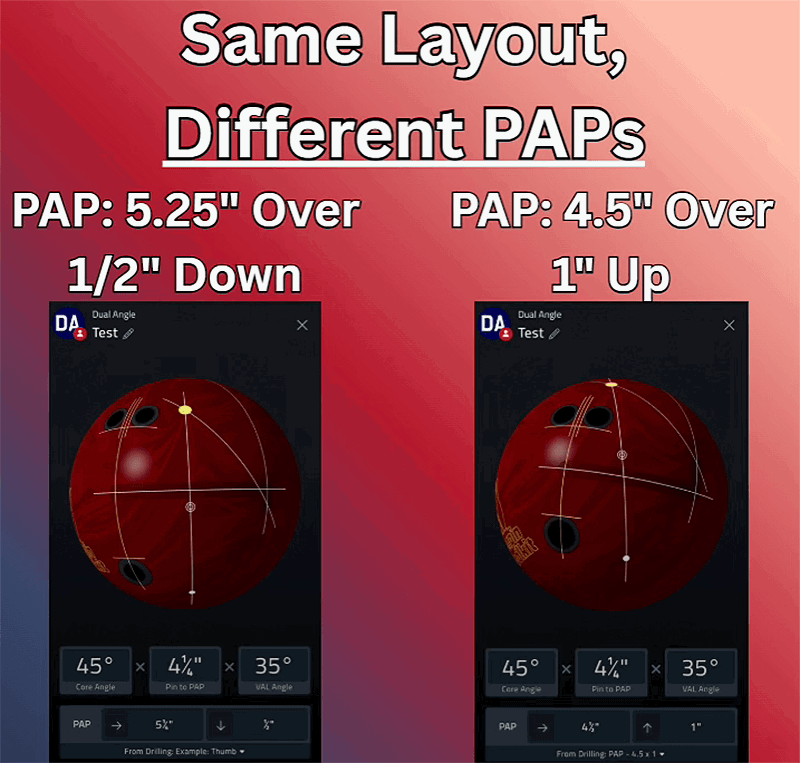
Two bowlers can throw the same ball with the same layout, yet the pin may be in completely different places on the surface, all because their PAPs differ. PAP ensures the layout is applied correctly for your unique release.
Below is an image that showcases this point:
Final Thoughts
Your Positive Axis Point is one of the most important measurements you can know as a bowler. It directly affects how your bowling balls are drilled and how they react on the lane. If you want predictable, optimized ball motion, you need your PAP.
Because releases naturally evolve over time, it’s smart to re-check your PAP every few months. Small changes in your game can shift your PAP, and keeping it updated ensures your layouts stay accurate.
Positive Axis Point Frequently Asked Questions
Q: What is the Positive Axis Point (PAP) in bowling?
A: The Positive Axis Point is the single point on the surface of the bowling ball that does not rotate when the ball first leaves your hand. It acts as the axle of the ball’s initial rotation. Every bowler has a unique PAP, typically located to the right of the grip for right-handed bowlers and to the left for left-handed bowlers.Q: Why is the Positive Axis Point so important?
A: Your PAP is the foundation for accurate ball layouts. Without it, every layout is essentially a guess. Pro shops use your PAP to correctly apply systems like Dual Angle, Vector Layout System (VLS), and 2-Handed Layout System (2LS). Knowing your PAP allows the pin and mass bias to be placed correctly for your unique release, giving you more predictable and optimized ball motion.Q: How do I find my Positive Axis Point?
A: Throw a few shots without wiping the oil off the ball. Locate the center of the first oil ring closest to your grip and mark it with colored tape. Record your release and adjust the tape until it stays still at release (no spinning). Once stable, measure the horizontal distance from the center of your grip to the tape, then the vertical distance up or down from that line. Those two numbers are your PAP.Q: How is a PAP measurement expressed?
A: A PAP is written as two numbers: horizontal distance (over) and vertical distance (up or down). Common examples include 4.5" over, 1" up; 6" over, 2" down; or 3" over, 0" (on the midline). These measurements tell the pro shop exactly where to place the layout relative to your grip.Q: How often should I re-check my Positive Axis Point?
A: It is smart to re-check your PAP every few months. Releases naturally evolve over time with changes in form, strength, or technique. Even small shifts can move your PAP, and keeping it updated ensures your layouts remain accurate and your arsenal continues to perform as intended.More Recent Bowling Tips Articles

Ten Things To Do Before Your League Season Begins
The first night of league has a habit of showing you everything you skipped in the off-season. A thumb that hangs. Grips that are slick. A slide sole that grabs. A ball that has not seen a spinner since March. This is the ten-thing checklist we run before week one: fit, equipment, surface, shoes, a little practice, and the boring stuff in the bag you only notice when it is missing. Do it now and you walk in ready. Skip it and you spend night one solving problems instead of bowling.
Read ArticleEntry Angle Is Everything: How Driving the 5 Pin Turns Pocket Hits Into Strikes
Tired of hitting the pocket all night and still leaving corner pins? Check out our full article on entry angle, the measurement that separates pocket hits from strikes. Learn why the 5 pin is your best diagnostic, what the ideal entry window looks like, and how to create more angle with your release and equipment. Read the complete guide here!
Read Article