Bowling Tips Frequently Asked Questions
updated: October, 2026Have a question about bowling tips? This is the place where we've gathered all our questions about bowling tips from our guides, articles, and product pages, all searchable and organized by topic, so you can find expert answers quickly and get back to bowling. For the quickest answers, use the search bar below.
Bowling Tips Questions by Topic
Recent Bowling Tips Questions
Q: Should I buy a new bowling ball before league starts?
A: Yes, if you need a replacement, a spare ball, or a piece that fills a gap in your arsenal. Buy and drill it before week one so you have time to practice with it, adjust the surface, and learn how it fits into your lineup. Last-minute purchases rarely give you that extra time.Q: Why is practice before the first league night so important?
A: Walking into week one cold is a common reason for a slow start. Even a short practice session helps you get your timing, footwork, and release back. The first night of league is often the lowest-scoring night of the season, and a little pre-season practice can prevent that.Q: What accessories should I have in my bag before league begins?
A: Have thumb tape, a rosin or grip sack, ball cleaner, scissors, and extra interchangeable thumbs if you use them. Running out of tape or forgetting a shammy on week one is an easy problem to avoid with a quick bag check.Q: What should I check on my bowling equipment before league season starts?
A: Check your ball fit, inspect balls for cracks or chips, refresh surfaces, replace worn finger grips, and inspect your shoes and slide soles. Also restock essentials like tape, rosin, cleaner, and extra thumbs. Small issues that seem minor in the offseason become big problems on week one.Q: How often should I replace my finger grips?
A: Finger grips should be replaced about every 60 games. Old grips get slick, lose their shape, and make your release feel inconsistent. Replacing them before league starts gives you a clean, secure feel from the first night.Q: What is a good entry angle in bowling?
A: Most coaches consider roughly 4–6 degrees ideal at the pocket. Under about 3 degrees, deflection becomes a serious problem; above that, pin wrap and inconsistent trip 4s show up.Q: Why does the 5 pin matter for strikes?
A: The 5 pin sits directly behind the 1–3 pocket path. A ball with proper entry angle drives it backward into the rear pins. If your 5 pin barely moves, the ball isn't driving through the rack, and corners will stand.Q: Does entry angle matter more than pocket percentage?
A: Yes. Hitting the pocket 90% of the time with a shallow angle produces fewer strikes than pocketing 70% of shots at a strong angle. Quality of contact beats quantity.Q: How do I increase my entry angle?
A: Move deeper on the approach and swing the ball, adjust speed-to-rev ratio, or change equipment. Stronger cores and duller surfaces create earlier, steeper reactions. Layout changes from your pro shop operator shift breakpoint shape as well.Q: Can a weak entry angle be fixed without buying a new ball?
A: Often, yes. Deeper feet positions, increased axis rotation, softer ball speed, or resurfacing your current ball duller all steepen entry angle. Exhaust those options before shopping.Q: What is the Positive Axis Point (PAP) in bowling?
A: The Positive Axis Point is the single point on the surface of the bowling ball that does not rotate when the ball first leaves your hand. It acts as the axle of the ball’s initial rotation. Every bowler has a unique PAP, typically located to the right of the grip for right-handed bowlers and to the left for left-handed bowlers.Q: Why is the Positive Axis Point so important?
A: Your PAP is the foundation for accurate ball layouts. Without it, every layout is essentially a guess. Pro shops use your PAP to correctly apply systems like Dual Angle, Vector Layout System (VLS), and 2-Handed Layout System (2LS). Knowing your PAP allows the pin and mass bias to be placed correctly for your unique release, giving you more predictable and optimized ball motion.Q: How do I find my Positive Axis Point?
A: Throw a few shots without wiping the oil off the ball. Locate the center of the first oil ring closest to your grip and mark it with colored tape. Record your release and adjust the tape until it stays still at release (no spinning). Once stable, measure the horizontal distance from the center of your grip to the tape, then the vertical distance up or down from that line. Those two numbers are your PAP.Q: How is a PAP measurement expressed?
A: A PAP is written as two numbers: horizontal distance (over) and vertical distance (up or down). Common examples include 4.5" over, 1" up; 6" over, 2" down; or 3" over, 0" (on the midline). These measurements tell the pro shop exactly where to place the layout relative to your grip.Q: How often should I re-check my Positive Axis Point?
A: It is smart to re-check your PAP every few months. Releases naturally evolve over time with changes in form, strength, or technique. Even small shifts can move your PAP, and keeping it updated ensures your layouts remain accurate and your arsenal continues to perform as intended.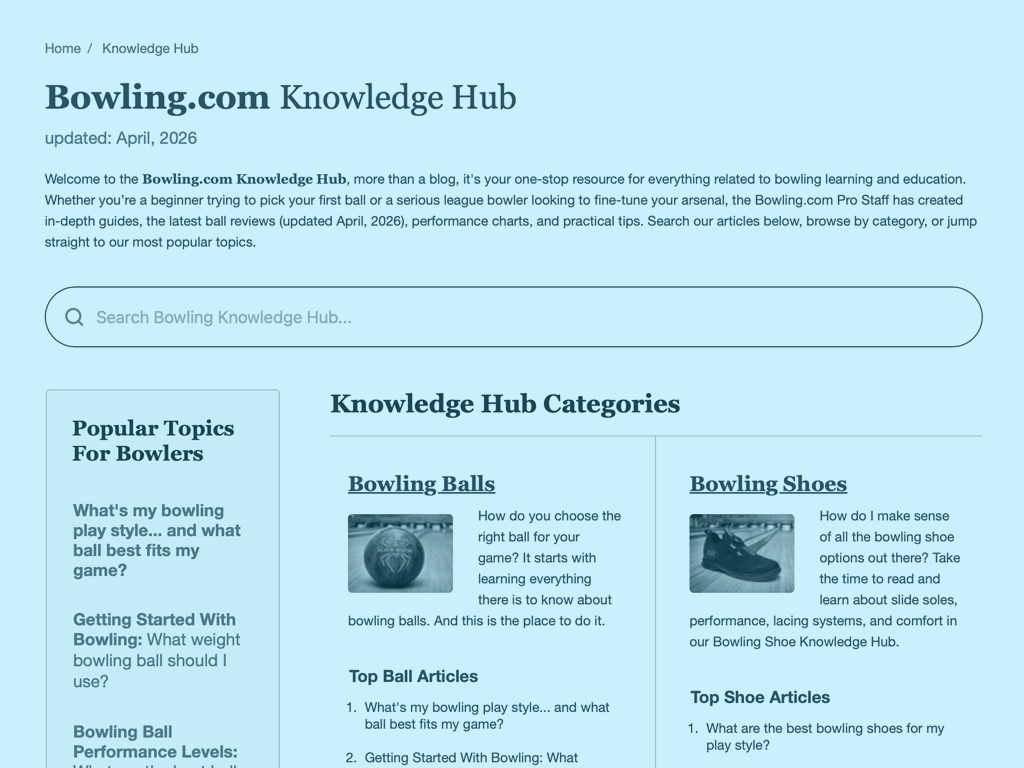
Bowling.com Knowledge Hub:
Your One-Stop For Bowling Education
More than just a blog, the Bowling.com Knowledge Hub is your one-stop resource for everything related to bowling learning and education. Whether you’re a beginner trying to pick your first ball or a serious league bowler looking to fine-tune your arsenal, the Bowling.com Pro Staff has created in-depth guides, the latest ball reviews, performance charts, and practical tips.