Clean vs. Dull:
What's the right surface for my bowling ball?
Bowling.com Pro Staff Posted: April 22, 2026
Updated: October 20, 2026

Quick Summary: This guide shows how a ball’s surface (clean/polished vs. dull/sanded) controls up to 70% of its hook. It explains the difference in lane reaction and shares simple ways to manage the surface of your bowling ball using towels, cleaners, polishes, and sanding pads for better scores on any condition.
Ever throw your favorite reactive ball on a fresh house shot only to watch it hook way too early and die in the midlane? Or maybe it skids forever on drier conditions and barely moves at the breakpoint, leaving weak hits. Frustrating, right? When you watch your bowling ball travel down the lane, it's easy to assume the hook you see is entirely the result of the high-tech core inside the ball. While the core is the "engine" that provides the potential for motion, the coverstock is the "tires", and up to 70% of a ball’s hook potential comes from its surface! No matter how powerful the engine, the ball will not perform if it can't find traction. This is where surface management comes into play.
Managing the surface of your bowling ball is the most effective way to change its reaction without buying a new piece of equipment. By choosing between a "clean" (polished) or "dull" (sanded) finish, you can dictate when the ball starts to hook, how hard it snaps at the back of the lane, and how it handles various oil volumes.
The Science of Friction: Why Your Ball Surface Matters
Every bowling ball has microscopic "teeth" on its surface. When a ball is sanded with a low-grit pad, those teeth are larger and sharper. They act like snow tires, digging through the lane oil to find friction early. This results in a "dull" finish.
When a ball is polished or sanded with a high-grit pad, those teeth are smoothed down. This allows the ball to glide through the oil with less resistance, storing its energy for the end of the lane. This is a "clean" or "shiny" finish.
Sanding Pads: The Foundation of Your Hook Shape
If you want to fundamentally change how your ball reads the lane, sanding pads are your most powerful tool. Leading brands like Abralon and Creating The Difference have revolutionized home surface management, allowing bowlers to adjust their own equipment at home or during practice.
How do I sand my ball?
- 1. Clean the ball thoroughly first.
- 2. Start with your target grit (or step through a few if doing a full resurface).
- 3. Sand in small, consistent circular motions, covering the entire surface evenly. Wet sanding with a bit of water or cleaner helps control dust and gives a smoother result.
- 4. Wipe clean, then test on the lanes.
- 5. For extra shine, follow high grits with polish.
The rule of thumb for sanding is simple: the lower the number, the earlier the hook.
- 500 to 1000 Grit: These are considered "rough" or "dull" finishes. They are ideal for heavy oil conditions or for bowlers with high ball speed who struggle to get their ball to slow down and turn. A ball at 500 grit will start its transition in the mid-lane, providing a smooth, predictable arc.
- 2000 to 3000 Grit: This is the "benchmark" range. Most modern reactive balls come from the factory somewhere in this neighborhood. It provides a balanced blend of mid-lane traction and backend continuation.
- 4000 Grit and Beyond: This creates a "clean" look. It is perfect for medium-to-light oil or when the lanes have "broken down" and the front part of the lane has become dry.
Products like the Abralon Sanding Pads are industry favorites because they feature a foam backing that ensures even pressure, preventing you from "flat-spotting" the ball. For those who want professional-grade consistency, TruCut Sanding Pads are specifically designed to leave a scratch pattern that matches the grit on the label, helping you repeat your results every time you resurface.
Cleaners and Polishes: Maintaining and Tuning
Once you've established the base grit of your ball, you need to maintain it. Lane oil is the enemy of friction. Every time your ball rolls down the lane, it absorbs oil into its pores. If you don't use the right cleaners and polishes, your ball will eventually "die," losing its ability to hook.
The Role of Cleaners
A good ball cleaner, does more than just make the ball look pretty. These formulas are degreasers that pull oil out of the coverstock pores. Using a cleaner, like Tac Up, after every session ensures that those microscopic "teeth" stay sharp and ready to grab the lane. If you don't believe me, just read our customer reviews. They often highlight that regular cleaning can extend the life of a ball significantly.
The Role of Polishes
If your ball is hooking too early and hitting the pins with no power, you likely need a polish. Bowling ball polishes like Storm Reacta Shine or Motiv Power Gel Shine add a layer of smoothness to the ball. Unlike sanding pads, which "cut" the surface, polish fills in the valleys of the scratch pattern to create a mirror-like finish. This creates a "skid-flip" motion, where the ball skids long through the oil and then makes a sharp, violent turn when it hits the dry part of the lane.
Towels and Shammies: The In-Game Heroes of Oil Control
While sanding and polishing are done off the lanes, surface management continues during the game. This is where Towels and Shammies become essential.
The Bowling.com Leather Shammy Pad is a favorite among competitive bowlers because leather has a natural ability to "grab" oil rather than just spreading it around. If you don't wipe the oil off after every shot, the ball will carry that oil back into the "track" area on the next throw, causing inconsistent hook and "skidding" past the pocket. Keeping your surface dry between frames is the simplest way to ensure your ball reacts exactly the same way every time you release it.
Practical Application: So which surface do I need?
To decide how to manage your surface, you have to observe how your ball is entering the "pocket" (the space between the 1 and 3 pins for right-handers, between 1 and 2 pins for lefties).
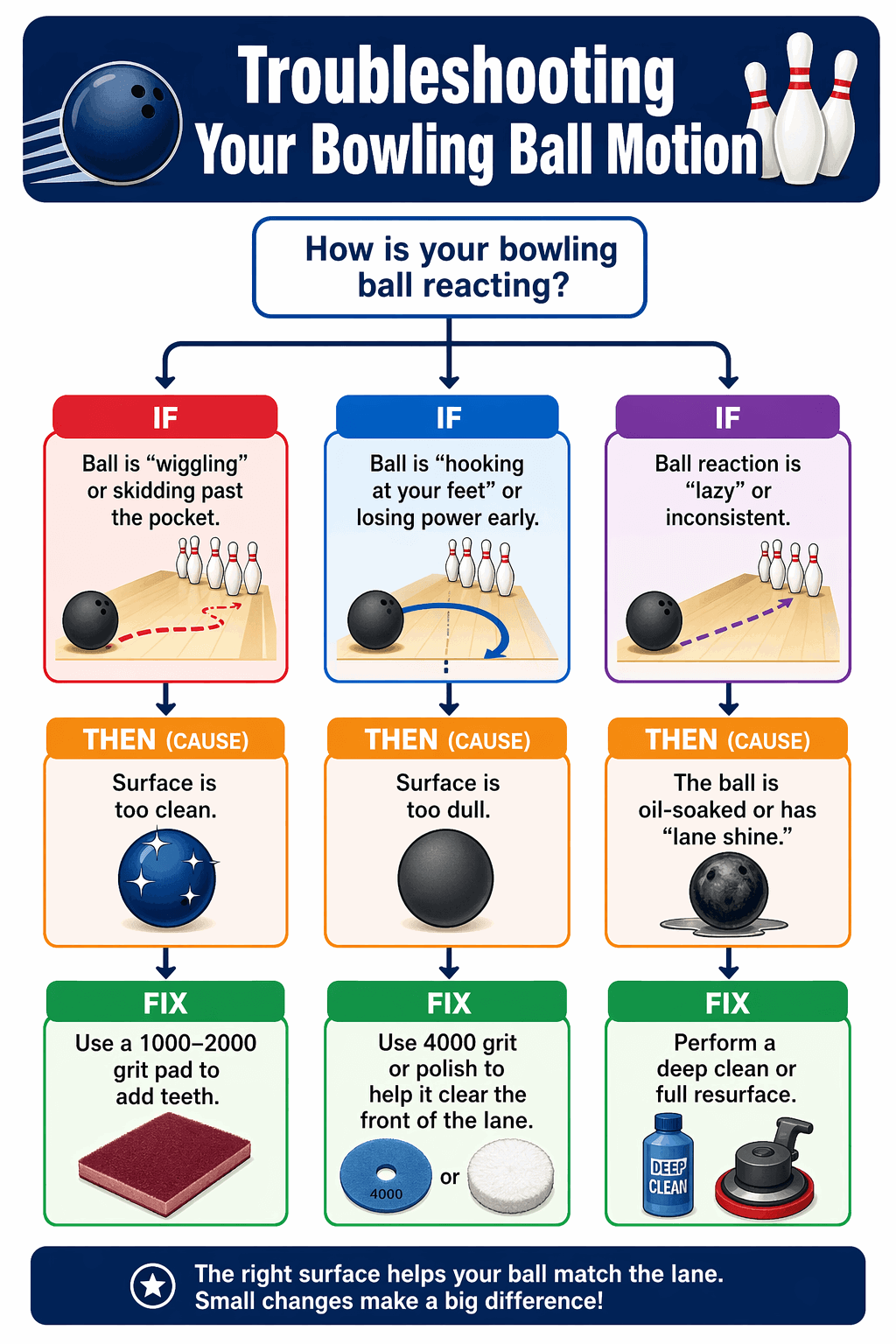
- 1. The Ball is "Wiggling" or Skidding Too Far: If your ball is sailing past the pocket or hitting the 5-pin, your surface is too "clean." Use a 1000 or 2000 grit sanding pad to dull the surface and create more traction.
- 2. The Ball is "Hooking at Your Feet": If the ball starts turning the moment it hits the lane and loses all its power before reaching the pins, it is too "dull." You need to move to a higher grit pad (4000 grit) or apply a coat of polish to help the ball clear the front part of the lane.
- 3. The Ball Reaction is Lazy: If the ball looks like it wants to hook but never quite finishes, it is likely "oil-soaked." It is time for a deep clean with an extra-strength product like Genesis Evolution Maxx to restore the tackiness of the coverstock.
Putting It All Together: Your Surface Management Routine
A simple routine keeps your balls fresh and your game sharp:
- Before every session: Quick wipe with a microfiber towel.
- After 3-6 games: Deep clean with a quality cleaner and see-saw.
- Every 20-30 games (or when reaction feels off): Resurface with sanding pads to your preferred grit, then polish if needed.
- Store balls properly (away from extreme heat/cold) and rotate your arsenal so no single ball takes all the abuse.
Surface management's a skill that separates the casual bowler from the expert. By investing in a small kit of sanding pads, a high-quality leather shammy, and a reliable cleaner, you gain total control over your game. You no longer have to hope the lanes "match up" to your ball, instead, you can change your ball's surface to match the lanes.
Whether you need the aggressive, early bite of a dull finish or the sharp, angular snap of a clean finish, the right accessories make all the difference. Explore our full range of surface management tools to keep your equipment performing like it just came out of the box.
Bowling Ball Surface Management Frequently Asked Questions
Q: Should my bowling ball have a clean (shiny) or dull (matte) surface?
A: It depends on your bowling style, rev rate, and the lane conditions you usually play on. A shiny (polished) surface gives the ball more length and a sharper backend reaction, which is great on drier lanes or for higher speed bowlers. A dull (sanded/matte) surface creates more friction for earlier hook and smoother overall motion, which performs better on medium to heavy oil.Q: What is the difference between a polished and a sanded bowling ball surface?
A: A polished (clean/shiny) surface reduces friction with the lane, allowing the ball to skid longer before hooking. A sanded (dull/matte) surface increases friction, causing the ball to read the lane earlier and hook more smoothly. The same ball can behave very differently depending on whether it is polished or sanded.Q: When should I use a dull surface on my bowling ball?
A: Use a dull (sanded) surface when you need more midlane traction or when the lanes have medium to heavy oil. It helps the ball start hooking sooner and provides a more controlled, arcing motion. Most league bowlers keep at least one ball with a dull surface for oilier conditions or when they want smoother overall reaction.Q: When should I use a clean (shiny) surface on my bowling ball?
A: Use a clean, polished surface when you want more length through the fronts and a sharper backend snap. This is ideal for drier lanes, higher ball speed bowlers, or when you need the ball to delay its hook. Many bowlers polish their pearl reactive balls to maximize backend reaction on typical house shots.Q: Can I change the surface of my bowling ball myself?
A: Yes, you can easily change the surface using sanding pads (available in different grits) or a ball spinner. Sanding makes the surface duller (more hook), while polishing compounds make it shinier (more length). Many bowlers adjust the surface of their balls regularly to match changing lane conditions.Need more info on bowling accessories? Search all of our bowling accessory articles above.
More Recent Bowling Accessories Articles

Are Shammy Pads and Microfiber Towels Better Than Your Old Cotton Towel?
Tired of your ball losing its hook or feeling “dead” halfway through a session? Ditch the old cotton rag and upgrade to a proper shammy pad or microfiber towel. These tools actually remove lane oil instead of smearing it, giving you cleaner, more consistent reactions and protecting your investment in reactive balls.
Read ArticleEssential Bowling Accessories: A Quick Guide by Category
Accessories are often the difference between a smooth league night and a frustrating one. High‑level bowlers rely on these tools to maintain their equipment, protect their hands, and stay consistent across changing lane and approach conditions. Use this streamlined guide to find the most important accessories every bowler should consider.
Read Article