

Bowling Balls Frequently Asked Questions
updated: June, 2026Have a question about bowling balls? This is the place where we've gathered all our questions about bowling balls from our guides, articles, and product pages, all searchable and organized by topic, so you can find expert answers quickly and get back to bowling. For the quickest answers, use the search bar below.
Bowling Ball Questions by Topic
Ball CoresBall CoverstocksBall Hook PotentialBall Performance LevelsBall Weight ChoiceBest Asymmetrical Core BallBowling Ball ArsenalBowling Ball ChoiceBowling BallsBowling Play StylesCheap Performance BallsCranker Play StyleSpinner Play StyleStraight Bowler Play StyleStroker Play StyleTweener Play StyleTwo-Hander Play Style
Recent Bowling Ball Questions
Q: What is a bowling ball coverstock and why does it matter?
A: The coverstock is the outer shell of the bowling ball that touches the lane. It controls how much friction the ball creates with the oil and dry parts of the lane, directly affecting hook potential, length, and overall reaction. Even with the same core, different coverstocks can make the ball behave very differently. The coverstock is one of the two most important factors (along with the core) when choosing a ball.Q: What are the main types of bowling ball coverstocks?
A: There are three primary types: Plastic (Polyester), Urethane, and Reactive Resin. Plastic has the lowest hook and is used mainly for spares. Urethane offers moderate, smooth hook with excellent control. Reactive Resin is the most popular for striking because it creates strong friction and hook. Reactive comes in three subtypes: Solid, Pearl, and Hybrid.Q: What is the difference between solid, pearl, and hybrid reactive coverstocks?
A: Solid reactive coverstocks have a matte finish and provide early traction with a smooth arc (best on heavier oil). Pearl reactive coverstocks have a shiny finish with pearl particles for longer skid and a sharper backend snap (best on medium to dry lanes). Hybrid reactive coverstocks combine both for balanced midlane read and backend reaction, making them very versatile on typical house shots.Q: Which coverstock should a beginner choose?
A: Beginners should start with an entry-level reactive resin coverstock (solid or hybrid) for learning to hook the ball. Plastic coverstocks are also good as a spare ball because they go very straight. Avoid high-performance reactive balls until you have consistent form, as they can be harder to control.Q: How does surface finish affect a bowling ball's reaction?
A: Surface finish greatly changes how a ball performs. Sanded or matte finishes increase friction for earlier hook and more traction (good on oil). Polished or shiny finishes reduce friction for more length and sharper backend (good on drier conditions). You can adjust the surface yourself with sanding pads or by taking it to a pro shop to fine-tune the ball to your needs.Q: Do I need an asymmetrical core if I’m just a league bowler?
A: Not necessarily. Most house-shot bowlers do great with symmetrical-core balls in the Entry-Level or Mid Performance category. Only move to asymmetrical when you feel your current ball lacks backend punch on heavier oil.Q: What’s the difference between low RG and high RG cores?
A: Low RG cores make the ball start rolling earlier (good on drier lanes). High RG cores let the ball skid longer before hooking (better on heavy oil). Most beginners prefer medium-to-low RG for easier control.Q: Can I change the core reaction by changing the coverstock?
A: Yes, but only to a point. A strong asymmetrical core with a pearl coverstock will still hook more sharply than the same core with a solid coverstock. The core sets the foundation; the coverstock fine-tunes it.Q: Are symmetrical cores only for plastic or entry-level balls?
A: No. Many Upper Mid and even some High Performance balls use symmetrical cores. They just pair them with stronger reactive covers for more overall power while keeping the motion smooth.Q: How important is mass bias in asymmetrical cores?
A: Very important. Mass bias is what gives asymmetrical cores their extra “snap” and angularity. Higher mass bias = more aggressive backend reaction, which is why these balls dominate on tough lane conditions.Q: What is the best bowling ball for a complete beginner?
A: Most beginners should start with a plastic (polyester) ball if they want to throw straight shots, or an entry-level reactive ball if they want to learn to hook. Popular plastic options include the Brunswick TZone series, Storm Ice, or Motiv Aspire. For those ready to hook, choose an affordable entry-level reactive like the Hammer Raw, Storm Tropical Surge, or Motiv Ascend. These balls are forgiving and help you develop proper form without being too aggressive.Q: Should I buy a plastic ball or a reactive ball as my first ball?
A: If you are brand new and just want to knock down pins consistently, start with a plastic ball for straight shots and easy control. If you plan to bowl regularly and want to develop a hook, go with an entry-level reactive ball. Plastic balls are cheaper and great for spares, while reactive balls give you more hook potential as your game improves.Q: How do I choose a bowling ball based on my speed and rev rate?
A: Determine if you are speed dominant (faster ball speed than revs), rev dominant (more revs than speed), or balanced. Speed dominant bowlers should choose stronger balls with more traction for better hook. Rev dominant bowlers need weaker balls to prevent over-hooking. Balanced bowlers do well with medium strength balls for versatility. Most new bowlers start with medium strength symmetrical core balls.Q: What core and coverstock should a new bowler look for?
A: New and returning bowlers should look for symmetrical cores paired with solid or hybrid coverstocks for smooth, controllable motion. Avoid high performance asymmetrical cores until you have consistent form. Entry-level reactive coverstocks provide a good balance of hook without being too difficult to control on house shots.Q: How do I know if my new bowling ball is too strong or too weak?
A: If your ball hooks too much and misses the pocket or leaves splits, it is probably too strong for your style. If it goes straight with little hook even when you try to rotate your wrist, it may be too weak. Start with a medium strength ball and adjust: move to a stronger ball if you need more hook, or a weaker one if you are over-hooking. Test on the lanes and get advice from a pro shop.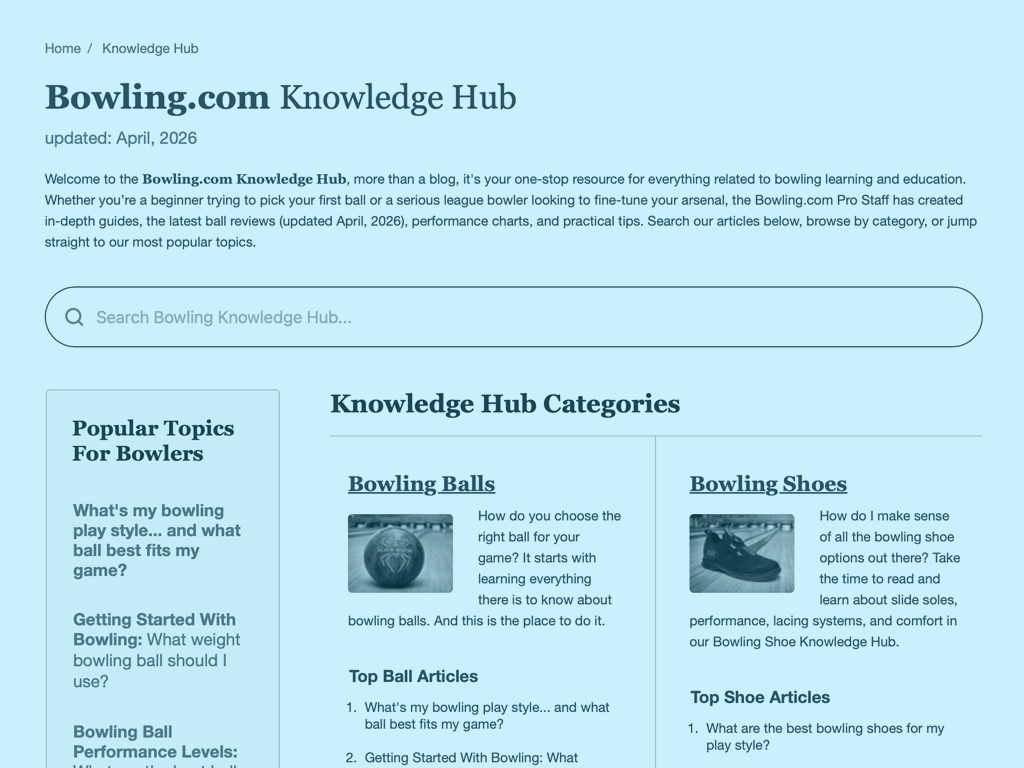
Bowling.com Knowledge Hub:
Your One-Stop For Bowling Education
More than just a blog, the Bowling.com Knowledge Hub is your one-stop resource for everything related to bowling learning and education. Whether you’re a beginner trying to pick your first ball or a serious league bowler looking to fine-tune your arsenal, the Bowling.com Pro Staff has created in-depth guides, the latest ball reviews, performance charts, and practical tips.


